Skybrush: A Bold Brush Font for Handmade Labels & Printables
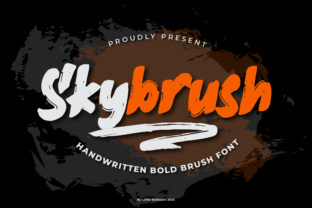
If you’ve ever spent hours tweaking a label design only to realize the font lacks presence—or worse, looks generic next to your carefully poured soy candle or hand-stamped greeting card—you know how much weight the right typeface carries. That’s why Skybrush has become my go-to display font for physical and digital craft products. It’s not just another brush script; it’s a bold, confident brush font with texture, rhythm, and unmistakable handmade charm—designed to hold its own on a shelf, a sticker sheet, or a wedding welcome board.
Skybrush delivers that authentic hand-brushed look without sacrificing clarity. Its thick, dynamic strokes taper naturally, giving each letter a sense of motion and intention—like something painted in one confident sweep. There’s no wobble, no unevenness that distracts at small sizes, and no fragile details that vanish when cut on a Cricut or Silhouette. That balance is rare. Many expressive brush fonts crumble below 24pt or get lost in fine print, but Skybrush stays legible even at 16pt on product tags or 12pt on delicate planner stickers—especially when used with clean spacing and moderate tracking.
I use Skybrush most often for short, high-impact text: brand names on boutique packaging, shop signage, seasonal labels (think “Pumpkin Spice” on fall soap bars or “Lavender Dream” on linen sachets), and foil-embossed invitation headers. It shines on cotton tote bags, ceramic mugs, and rustic wood signs—anywhere you want warmth, personality, and visual authority without looking overly ornate or dated. Because it’s a display font—not meant for paragraphs—it pairs beautifully with simpler companions: a crisp sans serif like Montserrat or Poppins for body text on printable templates, or a gentle serif like Playfair Display for elegant contrast in wedding stationery suites.
For SVG designers and digital product creators, Skybrush cuts cleanly. I’ve tested it across multiple machines and materials: vinyl on matte stickers, heat-transfer vinyl on tees, and even engraved acrylic tags—and every time, the strokes remain distinct and full-bodied. Just avoid ultra-tight kerning on small stickers (under 1.5" wide); opening up letter spacing by 20–30 units ensures clean separation during cutting and improves readability at arm’s length.
What makes Skybrush especially practical for commercial sellers is its versatility across formats and uses. It comes in standard OTF and TTF files—fully compatible with Canva, Adobe Illustrator, Cricut Design Space, Silhouette Studio, and Procreate. While it doesn’t include extended language support or dozens of stylistic alternates, it does offer thoughtful ligatures and basic swashes that add polish without overcomplicating your workflow. You won’t find 12 weights or a full variable axis—but you *will* get one strong, cohesive style that works immediately, without needing to hunt for the “right” variant.
Here’s where Skybrush truly earns its place in my font library:
- Candle & soap labels: Paired with a thin sans serif subheading (“Hand-poured • Small Batch”), Skybrush gives artisanal products instant credibility and warmth.
- Wedding welcome boards & seating charts: Its boldness reads clearly from across a venue, and its organic flow complements calligraphy-style accents.
- Digital printables: Planner covers, habit trackers, and affirmation cards gain visual hierarchy and emotional resonance—customers tell me they “feel more intentional” using them.
- Seasonal SVG bundles: Halloween “Boo!” banners, Christmas “Joy” ornaments, and Easter “Hop” tags all benefit from Skybrush’s playful yet grounded energy.
- Boutique gift tags & packaging: Printed on kraft paper or foil-stamped on recycled cardstock, it elevates perceived value instantly.
Readability matters—not just for your customers, but for your production. Skybrush holds up well in mockups and printed proofs, but always test at actual size before finalizing. On dark backgrounds, use a subtle white stroke or light shadow to ensure contrast. For small adhesive labels (like those on jam jars or bath bombs), stick to uppercase or title case—lowercase letters with tight counters (like “e” or “a”) can fill in if printed at low resolution or cut too finely.
Font pairing is where Skybrush really sings. Try it with a friendly handwritten font for secondary text—say, “Est. 2022” beneath a shop name—or layer it over a minimalist serif for wedding invitations where elegance meets approachability. Avoid pairing it with other heavy display fonts or overly decorative scripts; Skybrush commands attention, so let it lead while supporting fonts stay quiet and functional.
One note every seller should keep top of mind: Skybrush is a commercial font. Its license covers use in physical products (stickers, apparel, packaging), digital downloads (printables, templates, SVG files), and client work—no extra fees or attribution required. But always verify the license terms before bundling it into editable Canva templates or reselling as part of a design asset pack. When in doubt, check the original vendor’s policy—most reputable font shops clearly outline physical product rights, which Skybrush includes.
At its core, Skybrush isn’t about trend-chasing. It’s about giving your handmade business a voice that feels human, intentional, and memorable. Whether you’re designing a single Etsy listing or building a full brand identity, this brush font adds authenticity without demanding perfection—from your hands or your machine. It’s the kind of typeface that makes customers pause, smile, and remember—not because it’s flashy, but because it feels true.